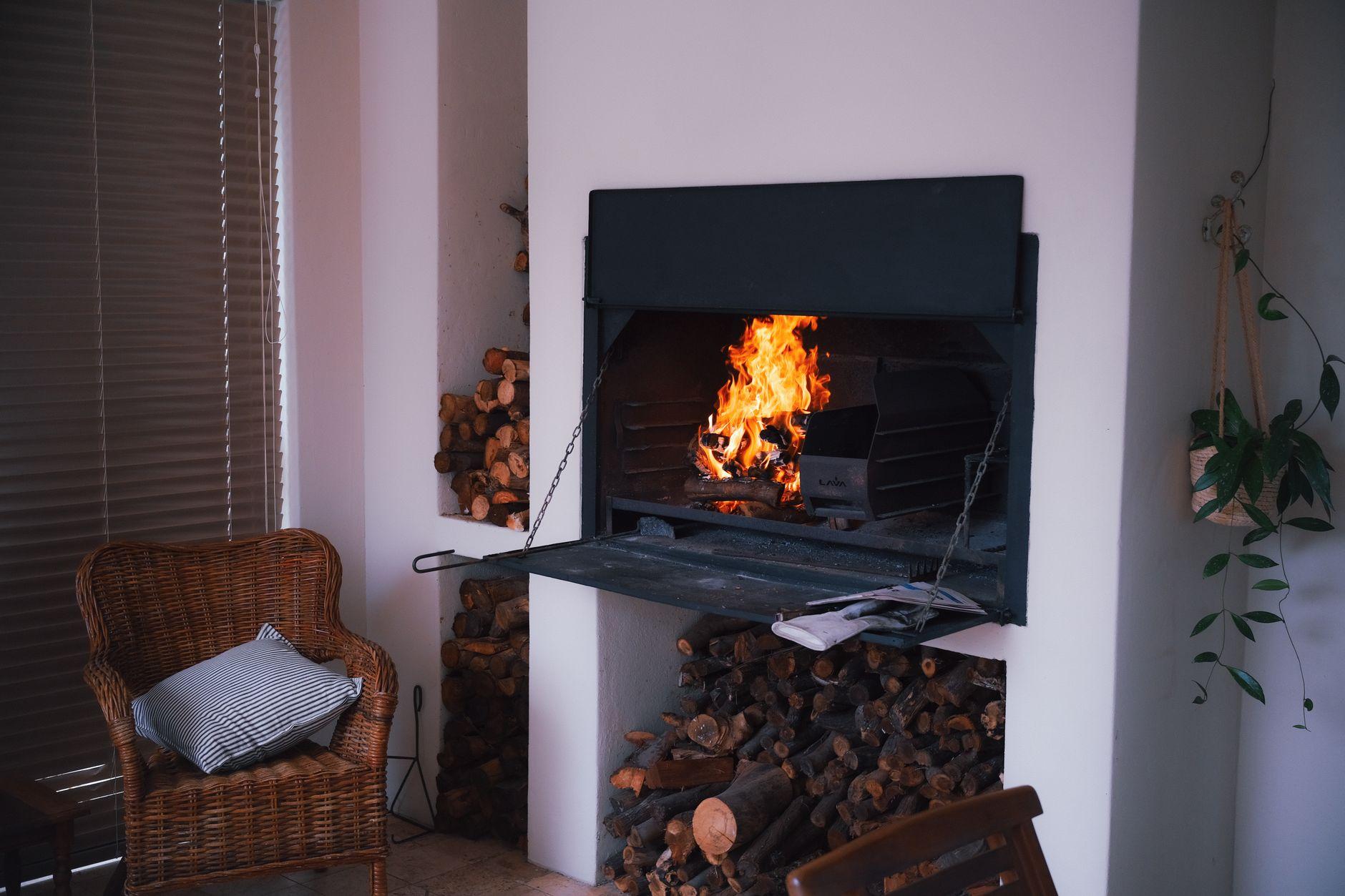
Most of the fireplaces we open in South Pasadena are brick, but the ones that cause the most confusion over money are the metal boxes: factory-built units framed into a wall, with a pipe running up inside a wood chase to a sheet metal top on the roof. They went into tract houses, condos and additions from the 1970s on, and they are priced differently from masonry because they are repaired differently. A factory-built fireplace is a tested assembly. The firebox, the pipe, the firestops and the termination on the roof were approved together, and that approval only holds when the parts that go back in come from the same listing.
The label sets most of the bill
Every factory-built unit carries a metal plate, usually riveted to a side wall inside the firebox or up near the damper, sometimes behind a louvered grille under the opening. It names the maker, the model and the standard the unit was tested to. Our first job on a repair visit is to find and read that plate, because almost every number that follows comes from it:
- Whether replacement parts are still made for that model, or by a company that took over the line.
- Which panels, dampers, grates and doors are approved for it.
- How much space the unit needs from framing, the mantel and the floor.
- Whether the maker approves any insert or gas burner for that box at all.
When the plate is missing or painted over, the work takes longer and the choices narrow. We can often identify a unit from its shape and its pipe, but a box we cannot name is a box we cannot order parts for, and that shows up in the estimate.
What the usual repairs involve
Refractory panels. The back and side walls of a metal firebox are lined with molded panels, not loose firebrick. They crack with age and heat, and each maker publishes its own limit on how much cracking is acceptable. A fine surface crack is usually left and noted. Once a chunk has broken off, or steel shows through a gap, we order the matching panel for that model and swap it in. We do not glue a broken panel back together, and we do not lay firebrick into a metal box that was never built for it.
Dampers. A prefab damper is a thin steel blade on a pivot, worked by a handle or a chain. Rust, a bent rod or a seized pivot are the common faults. Many can be freed or rebuilt with the maker's kit; some are better replaced by a listed sealing damper up at the termination.
Pipe and firestops. The flue in a factory-built system is metal pipe with two or three walls, locked together in sections. Sections can pull apart after the house settles or a rough sweep, and attic firestops sometimes go missing after a reroof or an insulation job. Those are safety items and go at the top of the list.
Doors, grates and screens. Glass doors belong to the listing too. An aftermarket door never approved for the box, or a grate so big it presses on the back panel, can make the unit run hotter than it was tested for. Swapping them for listed parts is usually a modest line.
What the bill tends to look like
We publish prices for a handful of jobs, and most factory-built work sits outside that list because two units of the same age can need very different parts. What we do publish:
- A visual look at the box, the pipe and the roof top: $52
- The same look plus camera footage of the whole pipe: $375
- Brushing soot out of the flue: from $400
- A new listed top for the flue: quoted on site
Panels, dampers, doors and pipe sections get a line each once we have read the plate and handled the parts. The written estimate names each part, says whether it comes from the maker or from an approved replacement source, and puts the labour beside it. If a part is no longer made, the estimate says so rather than offering a substitute that would void the listing.
Book a repair visit for the metal firebox. If you can read the maker and model off the plate, copy them into the form; it lets us check stock before the visit.
When a new unit costs less than fixing the old one
There is a point where patching an old prefab stops paying off. The usual signs: the maker has folded and nobody makes panels for that model; the firebox floor or back has rusted through; the outer casing has warped from years of hard fires. At that point the choices are a new factory-built unit set into the same framed opening, or a switch to gas with equipment approved for that space. A sealed gas heater fitted into an existing opening costs $2,650 to $5,350 installed, but many metal boxes are not approved to take one, so in practice the choice is often a complete new unit with its own pipe. We set both routes out on one estimate. The post on keeping or replacing a prefab goes through that choice in more detail.
Why masonry prices do not carry over
Owners sometimes show us a bid from a masonry crew for a prefab problem: rebuild the firebox, pour a crown, repoint the joints. None of that applies. A framed chase has no crown; it has a sheet metal top. A metal firebox has no mortar joints; it has panels and seams. When a factory-built system is worked on with masonry methods, it loses its listing, and an insurer or a buyer's inspector can flag it. Pricing the job to the maker's parts is what keeps the fireplace fit to use.
Where we work
Appleby Chimney Group is based in South Pasadena and covers Los Angeles, Monterey Park and Temple City. Prefab units are more common in the newer streets of Monterey Park and Temple City, and in South Pasadena condos and later additions, than in the old Craftsman blocks, but we see them in all four. The fireplace repair and fireplace inspection pages say what each visit covers.
Next move
Write to us through the contact page with what the fireplace is doing and where you found the plate, and the repair comes back to you in writing, part by part.
Want This Looked at in Person?
Appleby reads the label on the unit, checks it against the maker's listing, and writes each part and its figure down before any work. We work from South Pasadena across Los Angeles, Monterey Park, Temple City and nearby cities.